Gloopalaxy Post-Mortem
We started prototyping Gloopalaxy in October 2024, and finally released it in August 2026! 🎷🐛
Nearly 2 years of development, while working day jobs. This project taught us a lot, so I wanted to summarize here the lessons we learned from it.
Start small (really!)
And even then, Gloopalaxy wasn’t that “small” after all, given our situation… Without having to work on the side, the game would probably have taken ≈10 months to make.
We had already learned our lesson by ending development on our first, overly ambitious game and going from A to Z within this “small” scope makes me think I’ll probably never make a game bigger than this! 🫠
Playtest more
We developed most of this game while holding down day jobs, which forced us to work on “updates”.
In total, we created:
- A first prototype built in 1 week
- A Steam demo with 5 major updates
The upside of this approach was that we always had a complete gameplay loop to show during events. Unfortunately, with the limited time we had, we had to make decisions very (too) quickly, and we didn’t playtest each version of the game as much as we would have liked.
That was the most frustrating part because some design issues could have been avoided, but the further we got into development, the harder it became to make major changes.
Don’t delay art direction
It’s VERY important to start laying the groundwork for art direction early in the project. Seeing people in our circle who start with art direction almost before the game loop is fully finished, shows us this approach pays off more in terms of communication (and that can also help set the tone for the game).
With an early artistic direction, we can start sharing images that get people excited, create the Steam page, and collect wishlist entries as quickly as possible, etc. That wasn’t the case for us at first.
Besides, one of the “visual” issues with this game is that it has many “screens”: you look at the game through a screen, you see a spaceship, you see an aquarium inside the spaceship, you see the fishing menu in a small device… It’s always one thing inside another thing inside another thing. It was a problem for the communications, because we didn’t have much variety in the scenes to show, and the UI took up a lot of space, which is less engaging than a close-up of a nice scene.
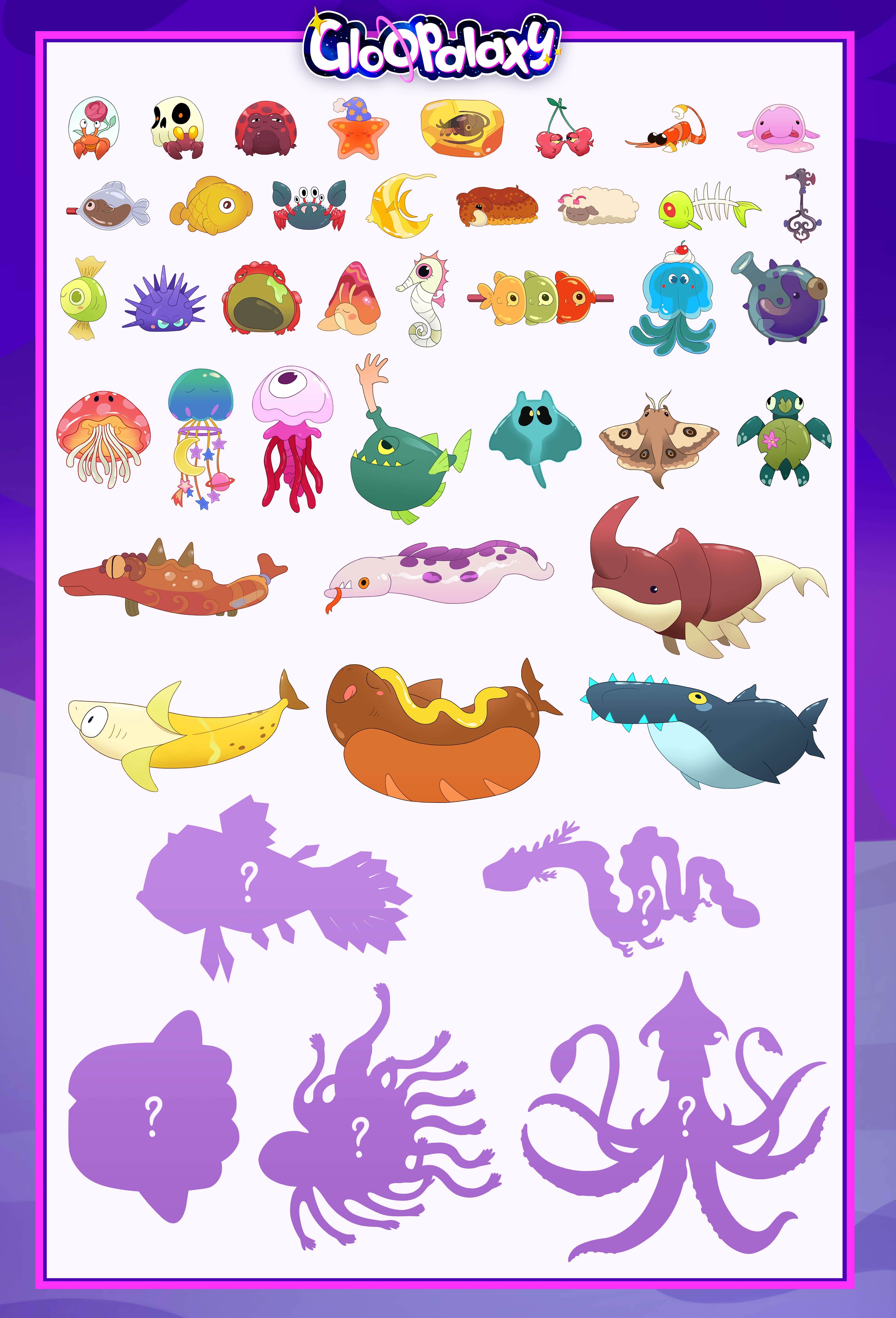 The fantastic creatures made by Garance Royère💜
Learn what and when to cut
This game taught us to let go of ideas and know when to cut them so we wouldn’t end up with an insanely broad scope. It allowed us to come up with ideas that weren’t too time-consuming to develop, which were just enough. That doesn’t mean slacking off on the project, but rather making the most of what we already have.
💡 One trick that worked well for me when I was too attached to an idea was to put it in the “backlog” to revisit it later. By not deleting an idea right away but instead setting it aside as a “nice-to-have,” I was able, over time, to naturally let go of it and delete it on my own!
It’s also very important to recognize where we stand mentally regarding the game’s development: We could have spent more time on Gloopalaxy, but even a “simple” mechanic actually hides a whole host of other tasks to be done: UI, art, sound design, debug, etc. But we just didn’t have the energy for it anymore; we have other project ideas and want to move on as it’s our first game.
Understanding Everyone’s Priorities
A best practice we’ll adopt for future projects is to make a list of priorities before development begins. What absolutely cannot change in the game because it’s important to us? What are we willing to change because it’s less important to us? What are our expectations for this game? Etc. This really helps us understand where everyone stands, and to keep in mind only what’s most important to everyone, the rest can easily be left out, so we don’t get stuck on things that aren’t working.
The same is true when it comes to the level of refinement we want to achieve; everyone’s “good enough” isn’t necessarily at the same level. What helped us avoid frustration was learning to take full charge of the part we wanted to refine, so we could go through as many iterations as we wanted without taking up the other person’s time, for whom that was more than enough.
The numbers!
- We collected more than 5,000 wishlists
- Two months after its release, we’ve sold nearly 1,000 copies, which is much more than we had hoped for!
- We managed to put together 2 bundles featuring some really cool games and developers!
- We have about ≈30 “positive” reviews on Steam
Overall, we’re very happy with the release, especially for a debut game!!
What’s Next
I’m taking on solo development for my next game; I’ve already started and will be writing posts about it soon! As for Robert, he’s working on a game with a friend of ours (the developer of Legion Was Here). But we already have an idea for the next game we’ll make together after all this! 👀